What is Echinacea?
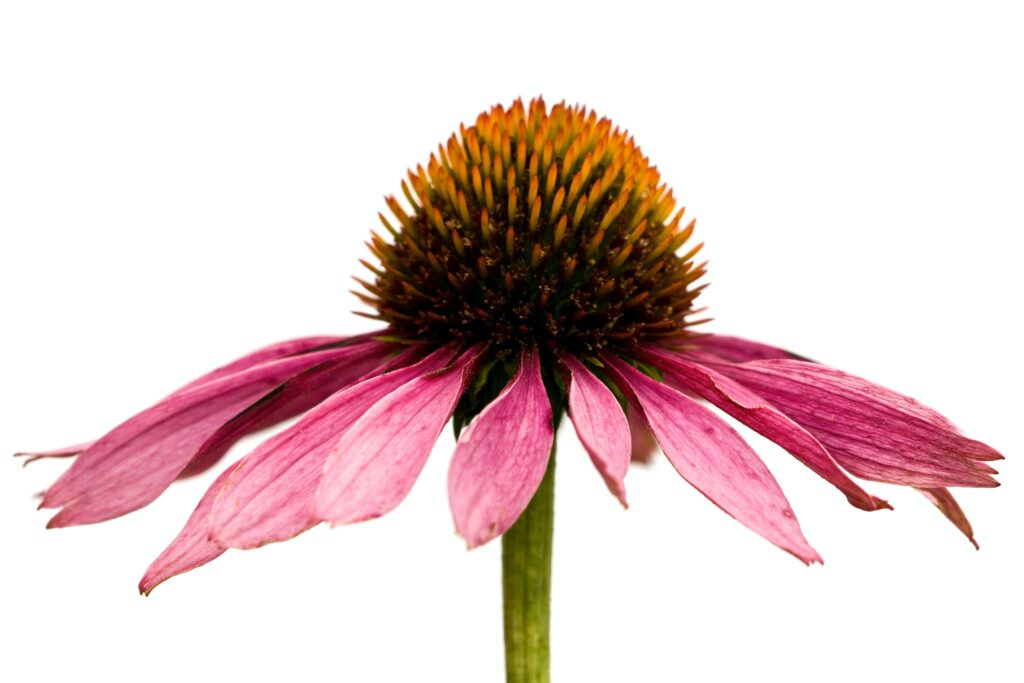
Echinacea is a flowering plant that comes from the daisy family. It has many varieties but the most commonly used are E. Purpurea and E. Angustafolia, or “purple cone flower”. The root was widely used by many Native American tribes both internally and topically. They used it for everything from skin rash and headache, to cold and viral illnesses.
Its westernized use began in the 1880’s by a salesman Meyer and Dr. King, who are largely responsible for the popular usage. Today, both the root and aerial, or ‘above ground’ parts are used. This cone flowered plant is said to be of great use as an immunomodulator.
Echinacea And The Immune System
Immunomodulators can either stimulate or suppress the immune system based on the body’s needs. Echinacea is most often extracted and used in an ethanol tincture to help shorten the duration of the common cold, medically known as rhinovirus. In recent decades its use has become even more popular which has effected the quality. There are even species that are simply ornamental and cannot be used medicinally.
Hudson (2012) suggests that echinacea has antimicrobial and antiviral properties and plays a role in stimulating phagocytotic activity. Phagocytes are super cool white blood cells that literally consume threatening viral and bacterial particles.
In fact, recent studies on the standardized preparation Echinaforce (EF, comprising ethanol extracts of E. purpurea, 95% aerial parts plus 5% roots) showed that this preparation was a very potent viricidal agent against several viruses” (p.3) not just the common cold. Furthermore, during a time of infection, echinacea provides high levels of antioxidants which can help with healthy cellular function, and immune system support.
In Catazarano’s recent 2018 study, the message is that the effectiveness lies within the preparation and constitution of the supplement. Unfortunatly, the herbal remedy market is so unregulated that it is hard to set clear guidelines for which tinctures are truly effective. She summarizes that many herbal immunomodulators could be effective and more cost efficient than many other over the counter medicines.
Know Your Source
I would highly suggest to purchase your Echinacea tincture from a trusted source. Local apothecaries may be a good place to start, but be weary of larger name groceries stores and brands. It is also important to note that goldenseal, often paired with echinacea, is a currently threatened species, and therefore should only be used if you need to call in a heavy hitter for a truly stubborn virus.
Healthline stands strongly by the use of echinacea for rhinovirus prevention and treatment as well as for its anti-inflammatory properties and, interestingly, to treat pain and migraines. They suggest that the purple coneflower is rich in antioxidants and other active compounds that warrant its therapeutic use. They summarize multiple studies to say that the immunity boosting properties are proven but that there is still a lack of research.
Also noted was that popular belief insists that echinacea’s primary benefit is in reducing the duration of upper respiratory infections, but there is also intrigue on how it can help come reduce anxiety or even help regulate blood sugar levels. It offers some elaboration on several studies that have been conducted without hidden agenda or marketing ploy.
Although some of the research lacks cohesion regarding Echinacea’s influence on the immune system and how it effects the common cold there is plenty of qualitative data. The fact that it has an impact on viral activity, whether it be directly with the viral RNA or with the stimulation of the immune system response, makes it a worthy option to reduce the duration and impact of the common cold.
Most of the research acknowledges that there is a need for more comprehensive and regulated study and also more strict regulations to ensure the data is clear and unified. In this growing field, the research is still young, even though the use dates back centuries. Personally, I look forward to following the growth of the research and watching it evolve over time and will keep YOU apprised to any new insights as well!!
References
Barrett, B., Brown, R., Rakel, D., Mundt, M., Bone, K., Barlow, S., & Ewers, T. (2010). Echinacea for treating the common cold: a randomized trial. Annals of internal medicine, 153(12), 769–777. doi:10.7326/0003-4819-153-12-201012210-00003
Catanzaro, M., Corsini, E., Rosini, M., Racchi, M., & Lanni, C. (2018). Immunomodulators Inspired by Nature: A Review on Curcumin and Echinacea. Molecules (Basel, Switzerland), 23(11), 2778. doi:10.3390/molecules23112778
Hudson J. B. (2012). Applications of the phytomedicine Echinacea purpurea (Purple Coneflower) in infectious diseases. Journal of biomedicine & biotechnology, 2012, 769896. doi:10.1155/2012/769896
Karsch-Völk, M., Barrett, B., Kiefer, D., Bauer, R., Ardjomand-Woelkart, K., & Linde, K. (2014). Echinacea for preventing and treating the common cold. The Cochrane database of systematic reviews, 2(2), CD000530. doi:10.1002/14651858.CD000530.pub3
Turner, R. B., Riker, D. K., & Gangemi, J. D. (2000). Ineffectiveness of echinacea for prevention of experimental rhinovirus colds. Antimicrobial agents and chemotherapy, 44(6), 1708–1709. doi:10.1128/aac.44.6.1708-1709.2000
Websites: